
Spandex Elastic Band Buying Guide: Width, Recovery & Yarn Thickness
Spandex elastic band is a narrow fabric containing elastane yarn that can stretch and recover repeatedly during wear. Choosing the right band requires more than checking the spandex percentage or nominal width. Buyers should first define the garment area, required holding power, comfort limit, target elongation, recovery, washing conditions, and skin-contact requirements. The Korean Hyosung 840D spandex crochet-knit band covered in this guide is listed as 80% polyester and 20% spandex, uses a 20-needle crochet-knit construction, and is intended for underwear, activewear, medical textiles, and other close-fitting applications.
Quick answer: how should you choose a spandex elastic band?
Begin with the application and comfort target, then verify performance with physical tests before confirming colour, roll length, and packaging. Crochet-knit spandex is often appropriate where a fine surface, soft hand, and close body conformity are important, such as underwear and sportswear binding. Woven elastic may be more suitable where a defined rib, jacquard logo, or different visual structure is required. In a quotation request, specify the garment area, width, force at a stated elongation, recovery, washing method, sewing process, colour, and test requirements. Do not treat 840D, 20 needles, or 20% spandex as a standalone quality grade; finished performance also depends on knit density, finishing, width, and the complete garment construction.
What is a spandex elastic band?
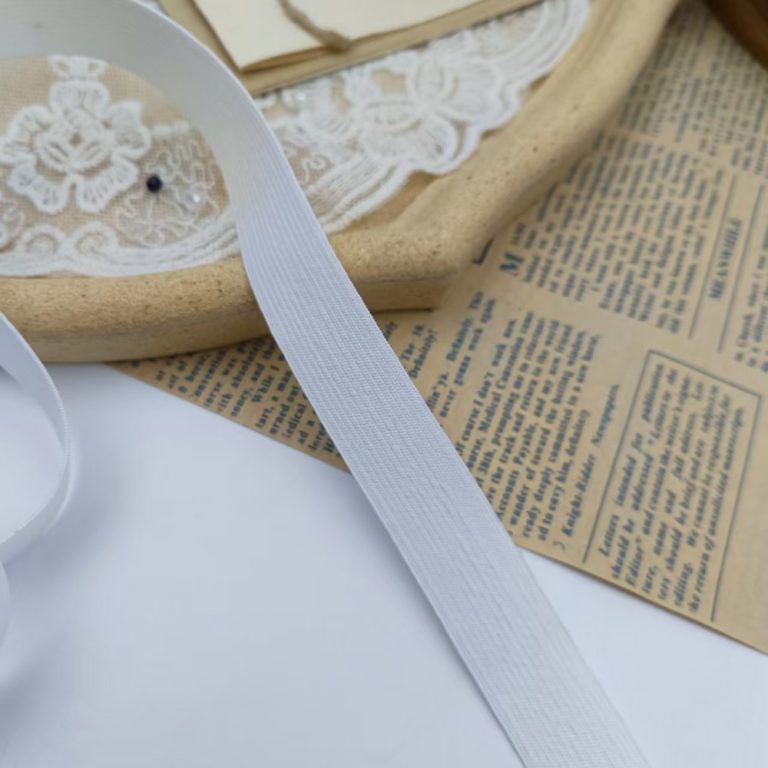
An elastic band is usually not made from spandex alone. Polyester, nylon, or cotton contributes dimensional stability and sewability, while spandex supplies stretch and recovery. The knit or weave determines density, thickness, texture, and holding power. The product page lists its composition as 80% polyester and 20% spandex, so this is a polyester-based crochet-knit elastic rather than a pure spandex tape.
In crochet-knit construction, elastic and companion yarns are formed into interlocking loops, producing a fine, continuous narrow fabric. Compared with some woven elastics, this type of construction can feel softer and follow body contours more closely, which is useful for intimate apparel. Edge curl, fraying, and sewing distortion can still occur and must be evaluated using the actual width, cutting method, sewing tension, and wash process.
What do 840D and 20 needles mean?
840D describes yarn linear density, not stretch ratio
“D” stands for denier, a measure of yarn linear density. The page identifies the spandex yarn as Korean Hyosung 840D. All else being equal, a heavier yarn may contribute a fuller band and greater recovery force, but finished performance also depends on spandex draft, polyester yarn, needle count, knit density, and heat setting. An 840D designation cannot be converted directly into a stretch percentage and does not replace a force-at-elongation test on the finished tape.
20 needles describes a knitting configuration, not a universal quality grade
The page calls for a 20-needle crochet-knit construction. The manufacturer describes the dense needle arrangement as supporting a fine, uniform surface and good body conformity. Buyers should still confirm the machine configuration for the exact width, because different widths, power levels, and textures may require different production settings. In particular, a 20-needle description should not be used to assume identical density, stretch, or holding force across every format up to the published maximum width.
Published specifications and what they mean for buyers
| Specification | Published information | What to confirm |
|---|---|---|
| Composition | 80% polyester, 20% spandex | Exact yarn specification, colour effects, and batch consistency |
| Elastane yarn | Korean Hyosung 840D spandex | Brand/specification evidence; do not equate 840D with finished elasticity |
| Construction | Crochet-knit, 20 needles | Needle configuration, density, thickness, and texture for the requested width |
| Width | 3–300 mm, customisable | Target width, tolerance, and machine configuration confirmed against the physical sample |
| Width tolerance | The page FAQ lists a usual tolerance of approximately ±0.5 mm | Specify the finished-garment requirement and cutting method |
| Colour | Black and white standard; custom colour for bulk production | Pantone or physical swatch, colour tolerance, and colourfastness |
| Certification | OEKO-TEX® STANDARD 100 | Current certificate, holder, product scope, and applicable product class |
| Minimum order | 3,000 metres | Final MOQ by width, colour, construction, and order mix |
| Lead time | Bulk: 3–15 days; samples: usually 3–7 days including colour matching | Schedule after sample approval, specification, and quantity confirmation |
Width note: The customisable range is 3–300 mm. Narrow lingerie trim and wide waistbands may require different machine settings, needle counts, density, and tolerances. Specify the target width, tolerance, and end use, then confirm sewing, recovery, and cutting performance with a sample at that width.
Do not choose spandex elastic only by maximum stretch
| Performance factor | Why it matters | How to evaluate it |
|---|---|---|
| Force at elongation | Defines how much holding force the wearer feels at the garment’s working extension | State original length, target extension, and test speed; measure force under those conditions |
| Recovery | Determines whether the band sags, puckers, or loses conformity after use and washing | Run repeated extension/release cycles and measure residual deformation |
| Wash stability | Controls shrinkage, edge curl, colour migration, and elastic fatigue | Wash and dry under the finished-product conditions, then compare width, length, recovery, and hand |
| Hand and thickness | Affects comfort, pressure marks, and the visual profile of the garment | Assess in sewn garment samples, not only as loose roll stock |
| Edge and sewing behaviour | Influences curling, fraying, skipped stitches, puckering, and seam failure | Sew trial coupons with the intended fabric, needle, thread, and tension |
| Colourfastness and material safety | Affects colour transfer, skin-contact suitability, and market compliance | Provide reports or a valid certificate covering the intended colour and use |
Asking only whether a band stretches 1:2 or 1:3 is rarely enough. Two suppliers may state the same stretch ratio, yet produce different force at the garment’s working extension, recovery speed, post-wash residual deformation, and hand feel. A better brief defines the acceptable force range and service conditions, then confirms the test method and results for the exact construction.
Application considerations
| Application | Typical garment areas | Selection focus |
|---|---|---|
| Underwear and lingerie | Waistbands, leg openings, shoulder straps, binding, and adjustable trims | Skin comfort, low curl tendency, wash recovery, and edge stability |
| Sportswear and shapewear | Waistbands, hems, binding, and support zones | Force at wear extension, breathability, sweat exposure, and intensive laundering |
| Medical and healthcare textiles | Care garments, abdominal support, fixation trims, and close-fitting components | Safety documentation, pressure comfort, cleaning, and applicable regulations |
| Apparel trim and narrow binding | Necklines, cuffs, hems, decorative inserts, and adjustable straps | Narrow-width consistency, colour uniformity, sewing tension, and post-wash appearance |
The product page positions this band for underwear and other close-fitting apparel, with additional uses in sportswear, medical textiles, and garment trim. Medical or children’s applications cannot be approved solely because a product is described as suitable for skin contact. Confirm the applicable regulations, test scope, certificate class, and labelling requirements for the finished item. For support products, buyers can also compare a breathable waistband elastic for abdominal binders and select according to pressure, breathability, and cleaning requirements.
How to test an elastic sample before bulk ordering
1. Measure width both relaxed and extended
Record the natural width and the width under the extension used in the garment. Paper-pattern slots, seam allowances, and fold depths should be checked with the band at the working extension. Otherwise, transverse contraction may lift the edge, expose the band, or create pressure marks in the finished product.
2. Sew a coupon with the actual shell fabric
Test the elastic with the intended shell fabric, lining, sewing thread, needle, and interlining. Record machine feed, elastic draft, and presser-foot pressure, then check whether the band recovers evenly after sewing. Testing loose roll stock alone cannot reveal fabric-thickness interactions, needle damage, or seam puckering.
3. Wash and dry the finished assembly as consumers will
Compare width, length, recovery, colour, and edge condition before and after washing, extraction, drying, and ironing. Look for increased curl, hardening, sagging, or dye migration. Good performance before washing should not be treated as evidence of long-term durability.
4. Verify the certificate, not just the certification name
The product page lists OEKO-TEX® STANDARD 100. Request the current valid certificate and check the certificate holder, product description, issuing institute, applicable product class, and validity period. Confirm that the selected colour and material are included. If the destination market or end use requires children’s, medical, or other testing, specify that separately; a general textile certification should not be used as a substitute.
5. Define bulk inspection before approving the sample
After the reference sample is signed, define acceptance criteria for width, weight or thickness, elongation and recovery, colour, splices, roll length, packaging, and visible defects. For projects with tight recovery requirements, retain the approved sample and batch test records so that hand feel and holding force do not drift between production runs.
Custom quotation checklist
- Finished product type, skin-contact area, wearing duration, and target level of support;
- Relaxed width, width tolerance, target elongation, and desired force at that elongation;
- Recovery, shrinkage, wash-cycle, and drying requirements;
- Whether the 80/20 composition is fixed and whether Hyosung 840D is mandatory or an equivalent yarn is acceptable;
- Pantone or physical colour reference, gloss, colour migration, and colourfastness requirements;
- Cutting and binding method, sewing equipment, shell fabric, needle, thread, and tension;
- OEKO-TEX certificate scope, destination-market regulations, and any additional third-party tests;
- Roll length, splice rules, labels, packaging, estimated quantity, and sample delivery address.
The product specification page lists a 3,000-metre MOQ and a standard bulk lead time of 3–15 days. Samples usually take 3–7 days including colour matching. Actual timing depends on width, colour, construction, approval speed, and order quantity. To discuss a specification, use the contact page to request pricing and a sample. Buyers comparing other elastics can review the elastic webbing category.
Frequently asked questions
Is 840D spandex always better than a lower denier?
No. Denier describes yarn linear density. Finished performance also depends on knit density, draft, heat setting, width, and companion yarns. A heavier spandex yarn may support a fuller band and greater recovery force, but could also affect softness, thickness, and cost. Specify the finished force, recovery, wash performance, and comfort target rather than selecting by denier alone.
Is 20% spandex enough?
There is no universal answer without the application. Lingerie binding, an activewear waistband, and a medical support component require different force ranges and comfort limits. The same 20% composition can perform differently when the yarn, knit structure, and finishing change. Confirm the exact band through fit and performance testing.
Can I customise a 3 mm width?
Yes. The product page lists a customisable width range of 3–300 mm. Because 3 mm is a narrow format, confirm the applicable needle configuration, width tolerance, elasticity, and MOQ in writing, and approve a physical sample for sewing, recovery, and edge stability before bulk ordering.
Will the band never curl or fray?
The manufacturer describes the dense crochet-knit structure as supporting edge stability, but no elastic can guarantee a particular result under every cutting and sewing method. Test the actual cut, shell fabric, sewing parameters, and wash process. Inspect the sewn sample again after laundering.
Does OEKO-TEX® STANDARD 100 cover every colour and application?
Check the current valid certificate rather than the product page’s certification label alone. The holder, product scope, test profile, product class, and colour coverage all matter. Children’s, medical, or market-specific requirements should be confirmed separately.
What are the MOQ and lead time?
The page states a 3,000-metre minimum order and a bulk lead time of 3–15 days. Samples usually take 3–7 days including colour matching. Final timing depends on width, colour, construction, and order quantity and should be confirmed in the quotation.
How can I reduce seam puckering or post-wash sagging?
Confirm pattern-slot dimensions, elastic draft, and sewing tension, then build a trial coupon with the actual fabric and thread. Check feed consistency, needle damage, and recovery after washing. Needle type, stitch, and tension should be established through a production trial rather than based only on the feel of loose elastic.
Purchasing note: Specifications in this guide reference Zivay Webbing’s Custom Spandex Crochet-Knit Elastic product page, reviewed on 1 November 2026. The width range is 3–300 mm. Elastic performance, post-wash stability, OEKO-TEX certificate coverage, and regulatory conformity must be verified in the quotation, approved sample, and test documentation.