
PVC-Coated Webbing: Specifications and Buyer Guide
PVC-coated webbing is a composite strap made with a woven polyester core and a continuous polyvinyl chloride (PVC) jacket. The polyester core provides the load-bearing structure, while the PVC surface resists liquid water and makes the strap easier to wipe clean. It is commonly used for outdoor gear, watersports equipment, utility straps, pet products, and equestrian components. The honeycomb waterproof PVC-coated webbing covered in this guide is made from 50% polyester and 50% PVC, is available in widths from 1 mm to 50 mm, and can be customised by colour, thickness, and surface finish.
Quick answer: is honeycomb PVC-coated webbing suitable for your product?
It is a practical choice when a strap must carry a load while also being exposed to rain, mud, wet hands, or frequent cleaning. PVC-coated webbing can improve moisture resistance and surface cleanability compared with ordinary uncoated webbing. Before ordering, confirm the required width and thickness tolerance, tensile strength and elongation, edge-sealing method for cut ends, and any regulatory tests required in the destination market. The supplied product page does not currently state a numeric tensile strength or a third-party certification for this item, so it should not be selected for safety-critical use without verified test data.
What is PVC-coated webbing made of?
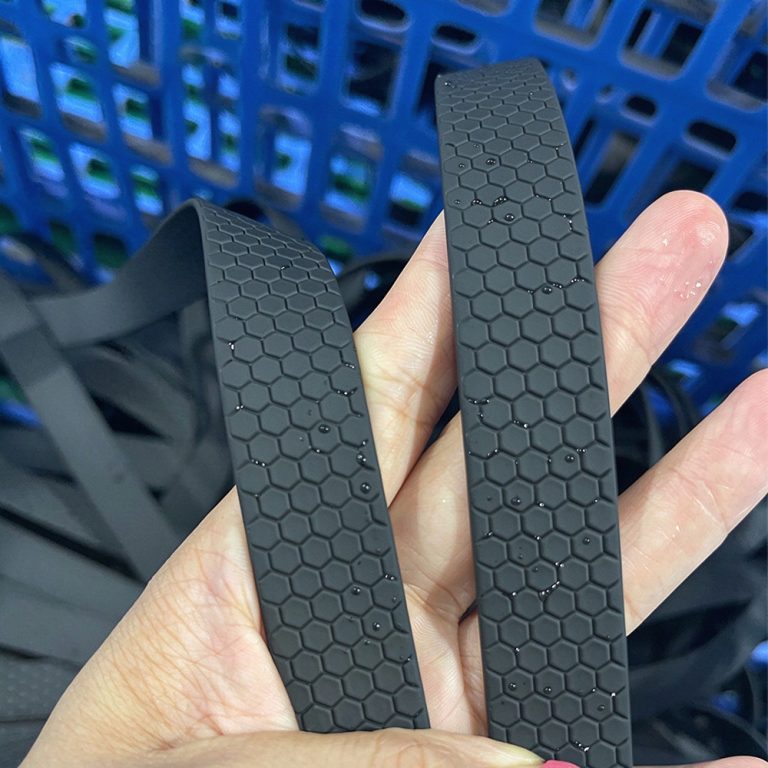
The construction combines three features that affect performance: a woven polyester core, a continuous PVC coating, and, in this product, a raised honeycomb pattern. The product page lists the material composition as 50% polyester and 50% PVC. That ratio describes the finished material composition; it does not mean that 50% of the width or thickness is the load-bearing core, nor can it be used to calculate tensile strength.
Woven polyester core
The yarn, weave density, and finishing of the polyester tape determine much of its baseline strength, stretch, and recovery. Two straps of the same width can perform differently if their construction differs. Buyers should therefore request tensile and elongation data for the specific construction rather than selecting on the word “polyester” alone.
Continuous PVC jacket
A PVC jacket over both faces and the edges helps limit water ingress through the tape and creates a surface that can be wiped clean. This construction is useful where a strap is repeatedly exposed to wet conditions. However, “waterproof” is not automatically a quantified rating. Performance after cutting, perforating, or sewing may differ from the intact roll, and indefinite immersion or pressure resistance should not be assumed without a defined test.
Honeycomb embossed surface
The raised pattern creates a more defined surface for wet or gloved hands and helps conceal minor scuffs and marks. It is a tactile and visual feature, not a certified slip-resistance rating, and it should not replace clamps, grips, or other engineering controls where a high level of slip prevention is required.
Key specifications at a glance
| Specification | Published information | What to confirm before ordering |
|---|---|---|
| Material | 50% polyester, 50% PVC | Coating formulation, flexibility, and market-specific compliance |
| Construction | Woven polyester core with continuous PVC coating | Edge coverage, coating adhesion, and flex performance |
| Width | 1–50 mm, customisable | Finished width and permitted tolerance |
| Thickness | Sample checks shown as approximately 1.10 mm for black and 1.08 mm for orange | Target thickness, gauge pressure, and tolerance; sample readings are not guarantees for every production run |
| Surface | Honeycomb emboss shown in both the black and orange colourways | Pattern scale, depth, hand feel, and suitability for the finished product |
| Colour | Black and orange are established; custom colours are available | Pantone reference or physical swatch, gloss level, and colour tolerance |
| Minimum order | 2,000 metres | Final MOQ for the chosen colour, construction, and order mix |
| Lead time | Bulk: 7–15 days; samples: usually 3–7 days including colour matching | Schedule after sample approval, specification, and order quantity are confirmed |
| Certification | No third-party certification is currently claimed for this item on the product page | Test standard, report scope, and acceptance limits for the intended application |
Where honeycomb PVC-coated webbing works well
| Application | Typical end uses | Design focus |
|---|---|---|
| Outdoor and camping gear | Backpack compression straps, dry-bag closures, tent and shelter tensioning, equipment lashing | Rain exposure, hardware compatibility, stitch holes, and cut-end sealing |
| Marine and watersports | Board leashes, kayak tie-downs, boat-cover straps, and equipment restraints | Repeated wetting and drying, salt exposure, and metal-hardware compatibility |
| Industrial and utility | Cable bundling, temporary securing straps, machine guards, and wipe-clean bindings | Oil or chemical contact, abrasion, working load, and safety factor |
| Pet and equestrian products | Collars, leads, harness components, and equestrian accessory straps | Edge comfort, skin-contact requirements, hardware strength, and material compliance |
The non-absorbent PVC surface is well suited to muddy, rainy, or frequently cleaned products. Performance still depends on the complete assembly. Sewing needles, punches, rivets, and open cut ends can create new water paths, while rough hardware may accelerate coating wear. Validate the webbing together with the finished edge treatment, stitching, hardware, and complete-product test.
How to specify PVC-coated webbing correctly
1. Start with the load case, not the width alone
Width changes the visual proportion and contact area, but it does not define strength by itself. Provide the expected working load, safety factor, load direction, attachment method, and maximum extension. Request tensile strength and elongation data for the exact width and thickness under consideration. For lifting, climbing, fall protection, or other personal-safety applications, use a product with an appropriate declared rating, traceable testing, and the required standards; general-purpose binding webbing is not a substitute.
2. Define what “waterproof” must mean
State whether the finished item will face rain, splashes, brief immersion, or prolonged immersion, and whether it will contact seawater, soap, oil, disinfectant, or another chemical. Also state whether the assembly will be sewn or perforated. A waterproof claim for intact coated webbing does not automatically apply to every finished product condition. If water resistance is a performance requirement, specify the complete-product test method and acceptance result.
3. Approve the cut-edge process before bulk production
A continuous PVC jacket can act as a barrier while the coating remains intact. Cut polyester ends, punched holes, and stitch holes may create new ingress paths. Test an appropriate hot-cut, heat-sealing, ultrasonic, or other edge-finishing process on production samples and verify appearance, flexibility, and strength.
4. Match colour and texture with a physical sample
Colours can be developed against a Pantone reference or buyer-supplied swatch. Black and orange are established options for this product. PVC gloss, honeycomb shadows, and screen calibration can all change the apparent colour, so approval should be based on a signed physical sample with agreed colour, thickness, and pattern tolerances.
5. Validate the complete conversion, not just the roll
At sample stage, evaluate hand feel, flex whitening, edge coverage, coating adhesion, cut-end sealing, sewing, and hardware assembly. Record the approved width, thickness, colour, texture, roll length, splice rules, packaging, and inspection method in a specification sheet. A bulk order should not rely only on a chat description or a product photograph.
Information to include in a quotation request
- The finished application and environment, including outdoor exposure, water, salt, oil, or chemical contact;
- Target width, thickness, tolerance, roll length, and estimated order quantity;
- Tensile strength, elongation, or other mechanical requirements, with a clear indication of whether the item is safety-critical;
- Pantone reference or physical colour swatch, surface gloss, and honeycomb pattern requirements;
- Cutting, heat sealing, punching, sewing, printing, hardware, and packaging requirements;
- Destination market, test standards, restricted-substance requirements, and required third-party reports;
- Sample delivery address, target delivery date, and bulk acceptance criteria.
The product specification page lists a 2,000-metre MOQ and a standard bulk lead time of 7–15 days. Samples are usually available in 3–7 days, including colour matching. Actual timing depends on the construction, colour, approval speed, and production schedule. To discuss a specification, use the contact page to request pricing and a sample. Buyers comparing uncoated constructions can also review the non-elastic webbing range.
Frequently asked questions
Is PVC-coated webbing fully waterproof?
When the PVC jacket is intact, the webbing is designed to limit water penetration in wet or intermittent exposure and is easier to clean than uncoated tape. It should not be assumed to remain waterproof after cutting or perforating, or to withstand indefinite immersion or water pressure without a defined test. Evaluate the finished assembly under its actual conditions.
Does the honeycomb texture reduce tensile strength?
The product page does not provide comparative strength data for embossed and plain versions, so a specific effect cannot be inferred from the photograph or pattern. If strength is a controlled requirement, test the exact finished construction rather than relying on a visual assessment.
Can the webbing be customised in colour, width, and thickness?
Yes. Width, colour, and thickness are made to order, and colours can be matched to a Pantone reference or physical swatch. The published width range is 1–50 mm. Confirm the achievable thickness range and tolerances with a physical sample before approving bulk production.
What are the MOQ and lead time?
The product page states a 2,000-metre minimum order and a standard bulk lead time of 7–15 days. Samples usually take 3–7 days including colour matching. The final schedule should be confirmed against the exact specification, quantity, and order date.
Can I cut or sew the coated webbing?
It can be converted into finished products, but each cut, hole, or stitch interrupts the continuous coating. Test the intended edge-sealing and sewing process on production samples, and verify that the finished item still meets its appearance, strength, and water-resistance requirements.
Is this product certified?
The product page does not currently claim third-party certification for this item. If the finished product must meet an EU, North American, or customer-specific standard, provide the required test scope and acceptance limits before ordering so that the available reports and test plan can be confirmed.
Purchasing note: Specifications in this guide reference Zivay Webbing’s Waterproof PVC-Coated Webbing, Honeycomb product page, reviewed on 1 November 2026. The thickness figures are sample measurements shown by the manufacturer, not a universal guarantee for every production lot. Tensile strength, regulatory conformity, water-resistance rating, and bulk tolerances must be confirmed in the quotation, approved sample, and test documentation.