
Small-Batch Pearl Pattern Webbing for Handbags: 500m MOQ & 100 Stock Colours
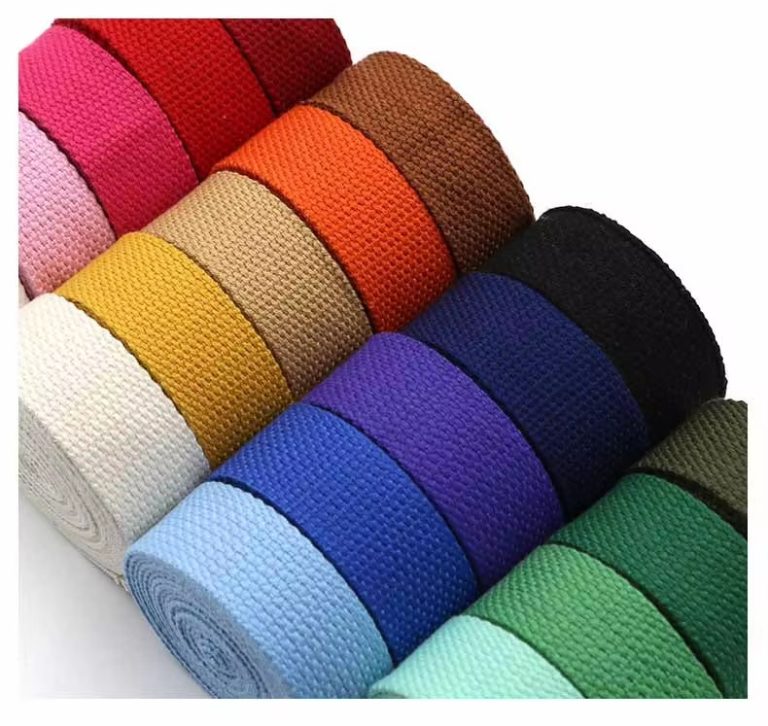
Small-batch pearl pattern webbing gives handbag makers a way to source narrow woven trim without committing to the quantities normally associated with a custom mill order. For this specific Zivay Webbing product, the product page lists 100 stock colours, five standard widths from 20 mm to 50 mm, a 1.3 mm thickness and a minimum order quantity of 500 metres. In Zivay’s product naming, “polyester-cotton” describes a cotton-like hand and appearance; the raw material is 100% polyester staple fibre, not a polyester/cotton blend. It contains no cotton fibre. Current stock is confirmed by width, colour reference number and requested quantity, so buyers should check availability before relying on a particular shade for a production schedule.
Quick answer: which webbing can Zivay supply for a small handbag run?
The Pearl Pattern Cotton-Feel Polyester-Cotton Webbing for Handbags is listed with a 500-metre MOQ and a range of 100 stock colours. It is available in 20 mm, 25 mm, 32 mm, 38 mm and 50 mm widths, with a stated thickness of 1.3 mm. The material is 100% polyester staple fibre; “polyester-cotton” is an industry descriptor for the cotton-like hand, not a declaration of cotton content. The product page gives a bulk lead time of 7–15 days and a sample lead time of 3–7 days, including colour matching. These figures apply to the listed product and should be reconfirmed with width, colour code and order quantity before purchase.
What counts as a small-batch webbing order?
“Small batch” can describe several different buying situations. A designer may need a short length for a prototype, a bag brand may order several stock colours for a capsule collection, or a manufacturer may place a low-volume production order after approving a sample. These needs should not be treated as identical because stock colours, custom colours and newly developed constructions have different minimum quantities and lead times.
| Buying stage | Typical requirement | What to confirm |
|---|---|---|
| Prototype | A physical sample to assess texture, stiffness, colour and handle construction | Sample availability, colour swatch, width and shipping cost |
| Sales samples | Short lengths in one or several collection colours | Whether every chosen colour and width is currently held in stock |
| Pilot production | A small commercial run before a larger seasonal order | MOQ per specification, cut length, packaging and production timing |
| Custom development | A new width, Pantone shade, logo or construction | Development MOQ, sample approval and bulk lead time |
The 500-metre MOQ shown for the pearl-pattern product is therefore most useful for buyers who need repeatable quantities across one colour and width, not for a one-off swatch request. A sample can be discussed separately, while the commercial order should be planned around the listed minimum and current stock position.
Product specifications at a glance
| Specification | Published information | Buyer action |
|---|---|---|
| Product | Pearl Pattern Cotton-Feel Polyester-Cotton Webbing for Handbags | Use the listed product name for the industry “polyester-cotton” description and specify 100% polyester staple fibre in the quotation |
| Thickness | 1.3 mm | Test stiffness, folding and stitching with the intended bag construction |
| Widths | 20 mm, 25 mm, 32 mm, 38 mm and 50 mm | Specify the finished width and confirm stock by width |
| Colours | 100 stock colours with reference numbers; Pantone matching available | Provide the stock reference or target Pantone shade and request a physical swatch |
| Construction | Woven pearl-pattern surface | Assess pattern scale, face texture and edge appearance against the design intent |
| MOQ | 500 metres | Confirm the final MOQ for the chosen colour, width and order mix |
| Lead time | Bulk: 7–15 days; samples: usually 3–7 days | Request a written schedule after stock and colour approval |
How to choose the right width for a handbag
Width changes both the appearance and the mechanical role of the trim. A narrow tape can work as piping, a decorative band or a light attachment, while a wider tape spreads the load across a shoulder strap or handle. The following selections are starting points for sampling, not universal construction rules.
| Width | Suitable starting point | Design checks |
|---|---|---|
| 20 mm | Slim shoulder straps, small bag handles, key fobs and fine trim | Inspect edge visibility, stitch allowance and pressure on the carrier |
| 25 mm | Compact handbags, crossbody straps and medium decorative bands | Check proportion against hardware width and bag scale |
| 32 mm | Tote handles, top-edge trim and mid-width straps | Test fold radius, topstitching and handle attachment |
| 38 mm | Wider tote handles and straps intended to distribute hand pressure | Review stiffness, hardware clearance and seam bulk |
| 50 mm | Statement handles, broad decorative panels and large bag straps | Approve the pattern appearance and full handle assembly in a physical sample |
Width alone does not determine load capacity. Handle length, attachment method, stitch pattern, interfacing, hardware and the rest of the bag construction all affect how the finished strap behaves. If the handle must carry a defined load, request relevant strength data and test the complete assembly rather than assuming that a wider tape is automatically sufficient.
Does “polyester-cotton” mean the webbing contains cotton?
In this product’s commercial naming, no. “Polyester-cotton” is used as an industry description of a cotton-like hand and appearance, while the raw material is 100% polyester staple fibre. It should not be read as a fibre-content declaration or confused with a polyester/cotton blend.
This distinction helps buyers avoid two opposite errors: assuming that the tape contains cotton when it does not, or rejecting the product because “polyester” appears in its material field. The practical specification is: a pearl-pattern woven webbing made from polyester staple fibre and selected for its softer, cotton-like hand. For any regulated or consumer-facing fibre claim, use the approved composition wording rather than the marketing description alone.
Stock colours versus custom colours
The stock palette is the practical route for many small collections because the product page lists 100 colour references. Buyers can select several shades for sales samples or a coordinated trim programme without starting a new dye lot for every colour. Even so, a website colour image should not replace a physical swatch: screen calibration, lighting and material texture can all change the perceived shade.
A custom colour developed to a Pantone reference is a different buying route. It may involve colour matching, sample approval and a separate minimum quantity. The lower commercial commitment of a stocked colour is therefore not evidence that every width, shade or finish is also available at the same MOQ.
Elastic versus nonelastic webbing for handbags
Small-batch sourcing depends on the product family. The pearl-pattern item covered in this guide is a woven, nonelastic handbag trim. Elastic webbing serves a different function: it introduces stretch and recovery into a waistband, binding or functional strap. A supplier’s stock-colour programme for one narrow fabric does not automatically apply to every elastic construction.
| Selection | Nonelastic pearl-pattern webbing | Elastic webbing |
|---|---|---|
| Primary role | Rigid or semi-rigid decorative structure, handle and trim | Stretch, recovery, fit or functional movement |
| Typical bag use | Handles, shoulder straps, edge trim and design accents | Internal bands, closures, adjustable components and elastic trims |
| Sample checks | Face texture, stiffness, edge stability and stitch appearance | Force at extension, recovery, garment/seam interaction and wash stability |
| MOQ | 500 metres for the listed pearl-pattern product | Confirm for the exact elastic construction, width, colour and quantity |
This distinction matters when comparing factories that support small batches. A useful quotation should identify the exact SKU or construction, distinguish stock from custom goods, and state the MOQ for each specification. A broad claim such as “no minimum” is not a reliable purchasing specification unless it is tied to a named product and current stock policy.
Where the pearl-pattern tape fits
The surface pattern is the defining visual feature, so the tape is most useful where the trim itself contributes to the bag design. Established applications for this product include handbag handles, shoulder straps, top-edge trim and decorative bands. It can also suit fashion accessories, belt-style trims, luggage tags and garment details that benefit from a woven face.
Before approving a colour, view it in the final lighting and against the main bag material. Before approving a width, sew the intended fold, seam and hardware attachment. The useful sample is not only a loose length of webbing; it is a representative piece of the finished handle or trim assembly.
800-metre project example
Suppose a studio plans 1,600 small bags and needs approximately 0.5 metres of webbing for each handle assembly. That calculation gives a material requirement of roughly 800 metres, before cutting loss, rejects and spare stock are added. Because 800 metres is above the listed 500-metre MOQ, the pearl-pattern product is a workable specification starting point if the required width and colour are available.
The calculation should be repeated for the real handle layout. Add an allowance for pattern alignment, test pieces, cutting waste, sewing rejects and future replacements. If several widths or colours are needed, confirm whether the 500-metre minimum applies to each specification or to a combined order; the product page does not establish a mixed-order rule.
How to place a small-batch order
- Define the finished application: state whether the webbing will become a handle, shoulder strap, edge trim or accessory band.
- Select a listed width: choose from 20 mm, 25 mm, 32 mm, 38 mm or 50 mm, or ask whether another width can be developed.
- Give a colour reference: send the stock colour number or the Pantone target rather than describing the shade only as, for example, “red”.
- State the quantity: provide estimated metres per colour and width, plus the intended order schedule.
- Request stock confirmation: ask whether the chosen combination is currently available and what minimum applies to the quotation.
- Approve a physical sample: test colour, surface texture, fold behaviour, stitching, hardware assembly and any necessary performance requirements.
- Freeze the approval: record the colour code, width, tolerance, quantity, packaging and delivery details in the purchase order.
Information to include in a quotation request
- Product name or link: Pearl Pattern Cotton-Feel Polyester-Cotton Webbing for Handbags;
- Material wording: 100% polyester staple fibre, with “polyester-cotton” used only as the industry cotton-feel descriptor;
- Width and desired tolerance;
- Stock colour reference or Pantone target;
- Estimated metres per colour and width;
- Intended bag application and whether the trim is load-bearing;
- Cut length, fold, stitch, hardware and edge requirements;
- Required sample date and bulk delivery date;
- Any destination-market testing, labelling or restricted-substance requirements;
- Packaging, roll length and shipment destination.
For a fast quotation, use the Zivay Webbing contact page and include the specification above. The sales team can confirm current stock, final MOQ, sample timing and production lead time for the selected width and colour.
Frequently asked questions
Is there a small-batch option for pearl-pattern handbag webbing?
Yes. The listed Pearl Pattern Cotton-Feel Polyester-Cotton Webbing for Handbags has a published MOQ of 500 metres and is offered in 100 stock colours. The final MOQ and availability should be confirmed for the exact width, colour reference and quantity.
Does “polyester-cotton” mean the webbing is a cotton blend?
No. In this product’s industry naming, “polyester-cotton” describes a cotton-like hand and appearance. The raw material is 100% polyester staple fibre and contains no cotton fibre, so the product should not be described as a polyester/cotton fibre blend.
Does the product have no minimum order quantity?
No. The current product page lists 500 metres as the MOQ. This is a low-MOQ, stock-colour option for the listed product, not a universal “no minimum” policy across every webbing construction.
Which widths are available?
The product page lists 20 mm, 25 mm, 32 mm, 38 mm and 50 mm widths. Confirm current stock for the exact width before placing an order.
How many colours are available?
The product is listed with 100 stock colours identified by reference number. Pantone colour matching is also offered, but custom colour development may have a different MOQ and lead time.
Can I order a sample before the 500-metre bulk order?
Samples can be discussed separately from bulk production. The product page gives an indicative sample time of 3–7 days including colour matching; sample cost, shipping and availability should be confirmed for the chosen width and colour.
What is the lead time for bulk production?
The product page states 7–15 days for bulk production. The final schedule depends on stock confirmation, colour, width, quantity and the point at which the sample and purchase specification are approved.
Can I customise the colour or add a logo?
Pantone colour matching and printed or woven jacquard logos are listed as available options. Send the artwork, target width and estimated quantity so the factory can confirm feasibility, MOQ, sampling and lead time.
Can I mix several colours or widths in one order?
Mixed specifications can be discussed, but a mixed-order MOQ should be confirmed in writing. The published 500-metre figure should be treated as the product’s listed minimum rather than an assumption that each colour or width can be supplied at a lower quantity.
Purchasing note: Product specifications in this guide come from Zivay Webbing’s Pearl Pattern Cotton-Feel Polyester-Cotton Webbing product page, reviewed on 8 November 2026. The raw material is 100% polyester staple fibre; “polyester-cotton” is used as an industry description of the cotton-like hand, not as a cotton-content claim. Stock levels, final MOQ, tolerances and lead times are confirmed by specification.